In addition to its festivals and traditions, good weather, y gastronomy, Malaga has a long history dating back thousands of years. Specifically to the 8th century B.C. It is therefore considered one of the oldest cities in Europe.
If you are thinking of visiting Malaga in the near future, we recommend that you soak up a little of its history so that you can enjoy it to the full and know the origin of every step you take on one of the continent's most ancient soils.
Malaga, or Malaka (the original name of the city), which has welcomed many different civilisations attracted by its strategic location by the sea, has architectural treasures and cultural traditions that bear witness to its rich history. We will now take a journey through time from the beginnings to the present day in one of the oldest cities in Europe.
On the other hand, if you want to travel not only through time, but also through your senses, then you should stop by the Cambara Restaurant and try one of its unique dishes, located in the Port of Malaga, a key place in the history of this city.
The first Malagueños were Phoenicians
The honour of being the first official inhabitants of Malaga goes to the Phoenicians. During the 8th century B.C. they created a settlement under the Guadalhorce river and called it Malaka, which translates to ‘’place of salting fish’’. Nearby were the Greeks who also founded a settlement near this area and created a colony called ‘’Mainake’’, which was later destroyed by the Carthaginians.
Roman period in Malaga
In 218 BC, the Romans expelled the Carthaginians and granted Malaga the status of a city confederated to Rome. Under Roman rule, Malaga underwent great commercial and architectural growth: the present-day Roman Theatre under the feet of the Alcazaba is just one of the proofs of Malaga's splendour under Rome.
Malaga: the Arab period
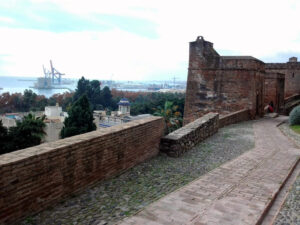
The Arabs, the next civilisation to inhabit Malaga, invaded the city and held it under their rule for almost eight centuries. Commercial activity in the area flourished and the population increased with the settlement of various cultures: Berbers, South Arabs, Mozarabs and Jews. With its seaport as a crucial point for trade and barter, it was a prosperous time for Malaga. The castle of Gibralfaro, with its walls and magnificent gates, the Alcazaba and the mosque of Calle Granada are a vestige of this period of prosperity.
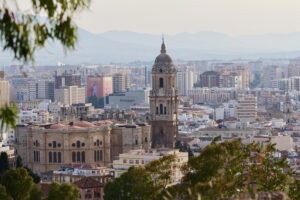
Later, however, a series of bad harvests, epidemics and floods devastated the city. In addition, an earthquake destroyed most of Malaga's buildings. Miraculously, the Cathedral of Malaga managed to survive.
Christian period in Malaga
After the expulsion of the Muslims from the whole of Andalusia, Malaga had become one of the most important commercial districts on the Mediterranean coast. An upper-class bourgeoisie emerged, made up mainly of two families, the Larios (hence the name of the Larios Street and the Heredia family, who contributed greatly to the industrialisation of Malaga.
19th century Malaga
The 19th century was a dark chapter for Malaga in which political and economic crises led to a period of decline. In addition, there were serious epidemics, such as the plague, which also devastated the region, and as a result, Malaga's maritime trade with America ceased, which led to the collapse of its main industry.
20th century to the present day
It was not until the second half of the 20th century that the capital of the Costa del Sol again experienced rapid urban and industrial growth as a result of the boom in tourism in the area and the export of fish.
Nowadays, Malaga is a modern city in which you can still find the vestiges of its past and whose rich heritage makes the city of the Costa del Sol a must-see. Above all, you should visit its historic centre, where you will find the Beluga Restaurant, recommended by the Michelin Guide, where you can savour the true history of the most southern and seafaring part of Malaga.